Total Pageviews

Friday, 20 May 2016

Kata Tjuta, not the Olgas


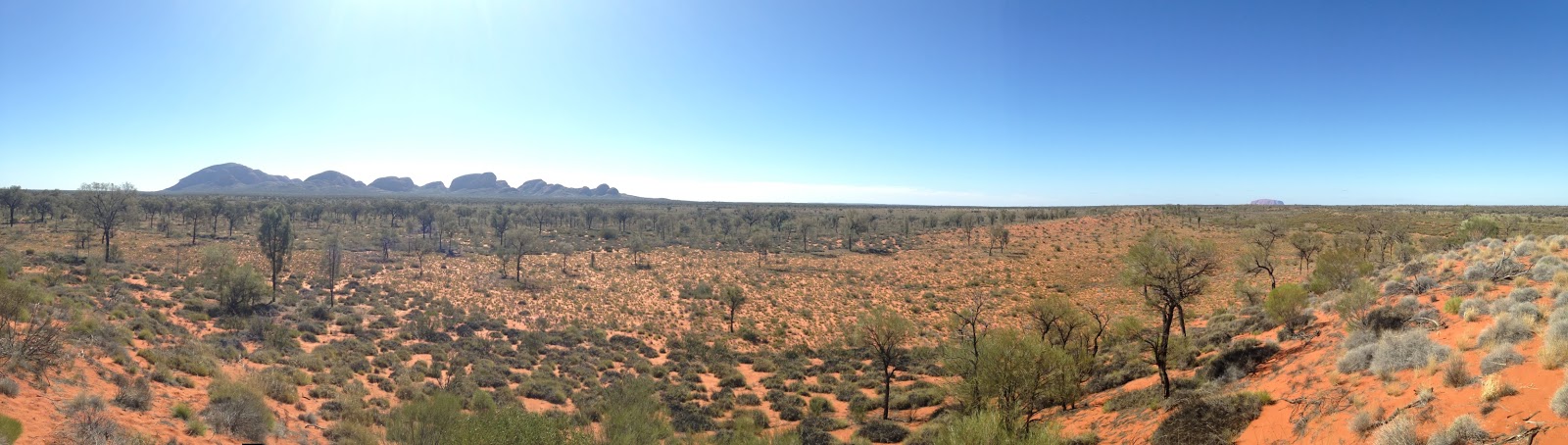
Kata Tjuta is an amazing outcrop of 36 domes rising from the desert in the Uluru-Kata Tjuta National Park. Kata Tjuta is Pitjantjatjara meaning 'many heads'.


Kata Tjuta viewed from the dune lookout
Some of you may know of, or have walked,  the Valley of the Winds. There is another shorter and easier walk, Walpa (windy) Gorge. It is a 2.6 km return Grade 3 walk. The gorge is a desert refuge for plants and animals. The track is rocky and rises gently with bridges over an impermanent stream.

The beginning of the Walpa walk.

You will be happy to know that there are no ugly trolls under any of the bridges on the walk, as we Billy Goats Gruff  dispatched them in the traditional fashion

Thursday, 19 May 2016

The Sun sets on Uluru

Any mention of Uluru would not be complete without the obligatory sunset photos.  However, communing with the rock at sunset is not the solitary, spiritual experience you may imagine. It is to be done in designated areas...one for folks in cars and the other for paying bus/coach types. Check out the picture below...see all those shadows in the foreground?  That is only a tiny sample of the couple of hundred people who joined me to gaze in awe the night we was there.


It is an amazing thing to see and different every night. Well worth elbowing others out of the way.

Wednesday, 18 May 2016

Uluru - Mala walk


You can walk the whole perimeter if Uluru which is around 10 kms... or enjoy views of the rock from the Mala walk which is a leisurely 2 kms return. It is named for the small marsupial hare-wallaby once numerous but now scarce because of predation by foxes and feral cats. A breeding program hopes to remedy this. The track visits significant indigenous ceremonial sites and has informative signs. To fully enjoy the experience, I suggest you take an enthusiastic five year old boy with you.


The teaching cave, where the grandparents schooled the  small children. 
Entrance to one of the women's caves.

Inside one of the women's caves

Rocks smoothed by thousands of years of grinding grass seeds to make flour.

The pool at the end of the walk is a permanent water source, recently refreshed by run-off from a rain event which happen only about six times a year. 

The Tjukurpa and Anangu people request tourists do not climb the rock due to its spiritual significance. On the day we were there, several people were on the climb totally disregarding the closed gate and signs declaring the climb closed due to high winds on the summit.

Look closely, you can see the fools up there. No wonder the Tjukurpa and Anangu call people who climb, 'ants'.

Sunday, 15 May 2016

Horizons #6 and # 7.

Somewhere along the Lassiter Highway - a celebration of the red!

View of Kata Tjuta and Uluru (if you look closely) from the dune viewing area on the way to Kata Tjuta.

Harmony and Art in Alice

Yesterday was Harmony Day in Alice Springs, with a celebration of diversity, in the park. There was music, dancing and drumming, national costumes, activities and delicious food.  For a smallish town, Alice is quite diverse with representatives from Sri Lanka, India, Africa and South America. I especially loved the junior Bollywood dancers, but my favourite, was Drum Atweme. The group is made up of indigenous children from the town camps and the program is run by the Tangentyere Council.

The town camps were established early in the town's settlement by europeans. The indigenous people were pushed together on the edges of the town. Not a very unique story, sadly.  The people were treated at as one homogenous group, whereas the continent consisted of many nations, cultures and language groups. The map below is an attempt to demonstrate this diversity. There is an interactive map here, if you want a closer look. Life has always been tough in these camps and today it is no different.  Programs, such as Drum Atweme which promote harmony and provide positive experiences and opportunities are vital.


Incidentally, I also attended the opening of two art exhibitions on Friday night. One of these was at the Tangentyere  Gallery.   The artists are all women and the paintings are a wonderful mixture of naive and contemporary depictions of traditional stories. The second exhibition, also showing art from indigenous women, was at the Raft Artspace and featured paintings and textile sculptures, I spent ages admiring these sculptures. Click on the link and scroll through the site to see some of them. They are made from old blankets and embroidered. I was lucky enough to meet a couple of the artists and they were rightly proud and happy to show their work. 


Friday, 6 May 2016

Alice has coffee!

When we did the 'Big Loop' in 2000, good coffee was nonexistent. The best was a milky instant coffee and the worst was an urn with make-it-yourself instant coffee, UHT milk and grubby cups and spoons. Boy how things have changed. Well I can't say that definitively for the outback in general, but in Alice Springs good coffee can be found.

Example #1 - The Coffee Horse, 8 Hele Street, Alice Springs.

Sarah, has great coffee, and whole food treats and amazing sandwiches, during the week and visits various festivals and events at other times. Check out her Facebook page to what she's up to and where she is.


Example #2 - The Watertank Cafe, 16 B Wilkinson Street, Alice Springs.

This funky cafe also has outstanding coffee, and a wide selection of yummy food. You can also enjoy a range of amazing local musicians every day they open. The best way to describe it is with pictures.
Great decor and atmosphere


Live music

And, do not fear, I am here for another month and I will continue to hunt for other great Alice coffee haunts.


Tuesday, 3 May 2016

Tjanpi desert weavers

Situated at the NPY Women's Council, 3 Wilkinson Street, Alice Springs is the Tjanpi Desert Weavers Gallery. Tjanpi, means 'dry grass'.  Basket making is not a traditional craft of the Western Desert but builds on traditions of using fibre for medicinal, ceremonial and daily purposes. It evolved from a number of workshops run in remote western communities by the NPYWC in 1995. Today over 400 women across 28 communities are involved in making baskets and fibre sculptures. Tjanpi weavers is aboriginal owned and run. The baskets and sculptures are sold at the gallery and the marked price reflects the amount of money which goes back to the women. 


When collecting desert grasses, women visit sacred sites and traditional homelands, hunt and gather food for their families and teach their children about country. The grasses are bound with wool, string or raffia and sometimes decorated with emu feathers and the red seeds from the bats-wing coral tree. 

Indigenous grasses, raffia and emu feathers.


My purchases

Each item has the name of the artist on the tag. My basket was made by Pollyanne Smith and here is some information from her biography:

'Pollyanne was born well in the bush near Ernabella in South Australia around 1957. She grew up and has spent most of her life in nearby Kaitjiti( Fregon), where she now works as a teacher at the school, as well as look after her grandchildren. In school holidays Pollyanne also paints at Kaitjiti Arts.  She first started making baskets in 2010 after seeing lots of other ladies in the community doing it.'

Thank you Pollyanne and the NPYWC.